
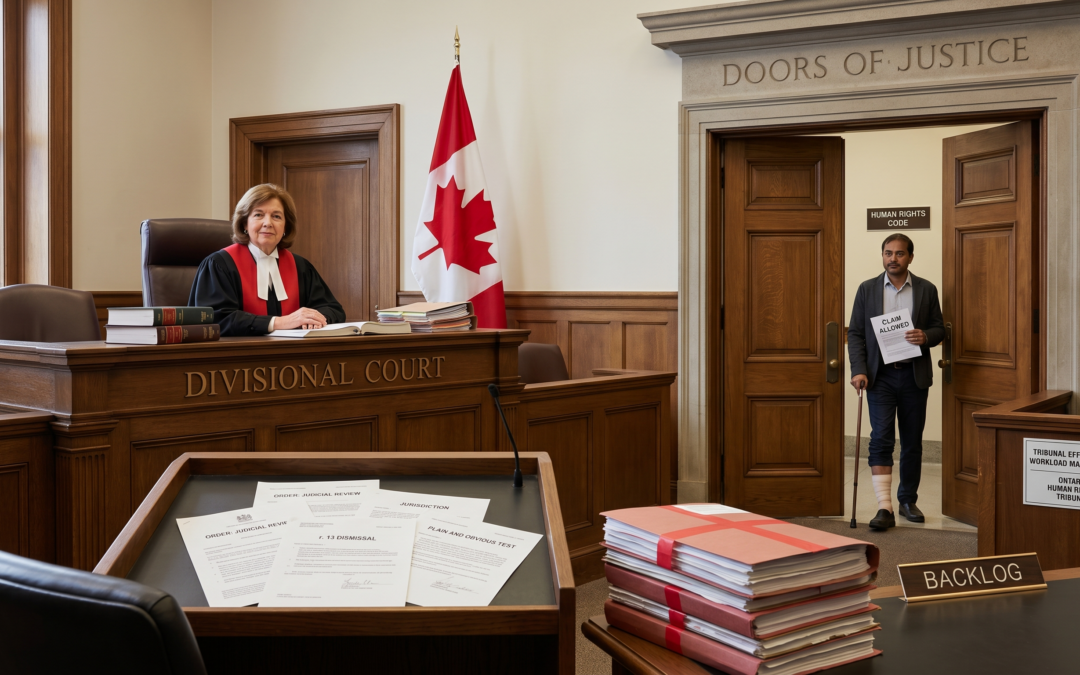
In Bokhari v Top Medical Transportation Services, 2026 ONSC, the Divisional Court (the “Court”) was asked to determine whether the Ontario Human Rights Tribunal (the “Tribunal”), correctly dismissed an application alleging discrimination in employment based on disability because it was outside of the Tribunal’s jurisdiction.
The Court found that the Tribunal’s decision was unreasonable, highlighting that the Tribunal’s effort to manage workload and efficiency cannot justify denying people who have been discriminated against from the protections of the Human Rights Code, RSO 1990 c. H. 19 (the “Code”).
Facts
The applicant Mr. Bokhari was employed as ambulance driver. He alleged that he injured his ankle and provided his employer with a medical note requiring he be off work for two weeks to recover. One week later, his employer terminated his employment, responding “I consider you quitting”.
Mr. Bokhari commenced an application before the Tribunal alleging discrimination in employment based on disability.
Seven months later, the Tribunal wrote to Mr. Bokhari with a Notice of Intent to Dismiss under r. 13 of the Tribunal’s Rules of Procedure (Dismissal of an Application Outside the Tribunal’s Jurisdiction). The Notice stated that an adjudicator had reviewed his application and determined that his application appeared to be outside the Tribunal’s jurisdiction (concluding the ankle injury was not a disability). The Notice also alleged that the application did not identify any specific acts of discrimination within the meaning of the Code and also stated that the Tribunal does not have jurisdiction over general allegations of unfairness.
In response to the Notice, Mr. Bokhari filed further submissions outlining the specific acts of discrimination and explained why the application was within the jurisdiction of the Tribunal.
Two months later, the Tribunal issued a decision dismissing Mr. Bokhari’s application concluding that there was nothing in Mr. Bokhari’s application or submissions in response to the Notice that indicated a connection to the Code and that the application did not therefore fall within the Tribunal’s jurisdiction (the “Jurisdictional Decision”).
Mr. Bokhari applied for reconsideration providing further submissions and a medical note; however, the Tribunal dismissed his request. In its dismissal, the Tribunal disclosed that it had made its Jurisdictional Decision based on a “balance of probabilities”, consistent with a January 2021 protocol and December 2022 Practice Direction on Jurisdiction. Notably, the Tribunal acknowledged that it had not applied the customary test it used in jurisdictional screening, in which the Tribunal would only dismiss the application for lack of jurisdiction if it were “plain and obvious” that the application is outside the Tribunal’s jurisdiction.
Mr. Bokhari sought judicial review of both decisions.
Issues
The Divisional Court (the “Court”) considered the following issues:
- Was it reasonable for the Tribunal to consider, as a jurisdictional issue, whether Mr. Bokhari’s ankle injury was a disability?
- Was it reasonable for the Tribunal to adopt the balance of probabilities standard in determining whether it had jurisdiction over Mr. Bokhari’s application?
- Was it reasonable for the Tribunal to conclude that there was no arguable case that Mr. Bokhari’s ankle injury is a disability on the facts alleged and the law?
- Did the Tribunal give Mr. Bokhari adequate notice of the case to meet in its Notice of Intention to Dismiss his application?
- The Tribunal performed a merits review, not a jurisdictional analysis
The Court found that the Tribunal almost immediately moved from assessing whether Mr. Bokhari’s application fell within the Tribunal’s jurisdiction to determining whether he could succeed in his application which was not a proper jurisdictional analysis. Once the Tribunal understood that the claimed debility could arguably be a “disability”, there was no jurisdictional basis to dismiss the application because determining whether someone has a disability under the Code requires a contextual rights-based inquiry, which considers the socio-political dimensions of discrimination.
- Applying a balance of probabilities standard to jurisdictional screening was unreasonable
The Court found that applying a balance of probabilities standard to jurisdictional screening was unreasonable as the Tribunal departed from its long- settled practice of using the plain and obvious test and that the Tribunal did not meet its justificatory burden for doing so.
The Court further noted the following:
Applying the balance of probabilities standard to jurisdictional questions inevitably results in screening out, at a threshold stage, applications that appear unlikely to fall within the jurisdiction of the Tribunal but which, with the benefit of a factual record and argument, would ultimately be determined to be within the Tribunal’s jurisdiction. This results in applicants who have been discriminated against being denied the Code’s protection. Managing workload and efficiency cannot justify this result. A higher threshold must be met before the Tribunal can reasonably close its doors to applicants on jurisdictional grounds under r. 13 [42]. Emphasis added.
- It was unreasonable to conclude that there was no arguable case that Mr. Bokhari’s ankle injury is a disability under the Code on the facts alleged and the law
The Court went on to find that the Tribunal’s analysis of Mr. Bokhari’s ankle injury was unreasonable because it adopted a biomedical model of disability and did not engage in a socio-political analysis of disability, as required by the governing jurisprudence.
Given its findings, the Court did not address the other issue argued (d) above, and set aside the Jurisdictional Decision thereby permitting the application to proceed.
Take-away
The Tribunal’s decision was questionable given that it was a marked departure from its own procedure and the copious caselaw that exists highlighting among other things, that assessing whether the injury was a disability for screening jurisdiction was inappropriate and that the plain and obvious test was overwhelmingly applied under r. 13.
The Court flagged that the Tribunal’s decision was likely driven by the need to address the ongoing backlog of applications and to improve efficiency; however, in a clear pushback against this possibility, the Court was clear that the Tribunal cannot alter its process in a manner that unfairly works against applicants.