
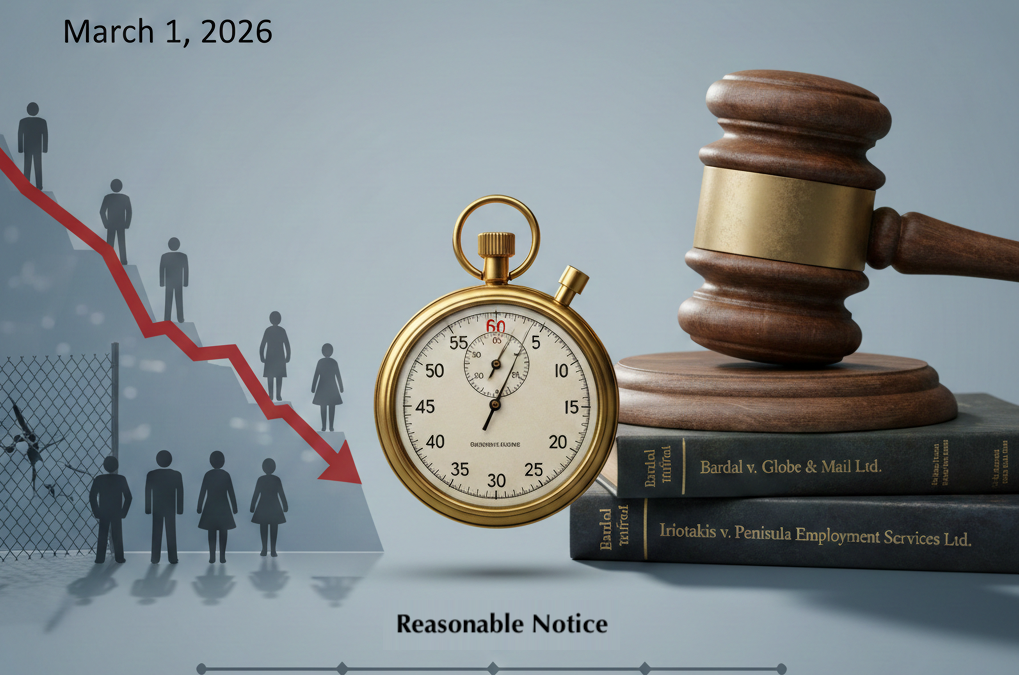
It is reasonable to expect that the period we are in right now economically with its high rates of unemployment, increased tariffs and economic uncertainty will impact employee entitlements to reasonable notice on termination of employment.
The factors which are considered at common law to determine an employee’s reasonable notice of termination were established in 1960 in the decision of Bardal v. Globe & Mail Ltd. O.J. No. 149 (H.C.J.). The analysis focuses on the application of the Bardal factors, which include the nature of the position held, the length of service, the age of the employee, and the availability of similar employment.
Our courts have historically recognized that adverse economic conditions, such as recessions or sector-specific downturns, can increase the reasonable notice period because they directly impact the time required to find comparable employment. It is important to note, however, that the economic state at the time of dismissal is the relevant consideration, not subsequent events.
Most recently, this same analysis was applied by the courts in cases arising during the COVID-19 pandemic which have reached trial. Terminations occurring during the pandemic, when economic conditions were particularly challenging, led to longer notice periods. However, terminations before the pandemic’s onset generally did not attract the same consideration.
Courts have consistently recognized that the pandemic’s economic conditions, such as reduced job availability and prolonged job searches, are relevant factors in determining reasonable notice entitlements. These considerations fall under the Bardal factor of “availability of similar employment.”
For instance, in Iriotakis v. Peninsula Employment Services Ltd., 2021 ONSC 998, the court acknowledged that the economic downturn caused by the pandemic could extend the reasonable notice period due to the depressed economy making it more difficult to find comparable employment. Similarly, in Kraft v. Firepower Financial Corporation, 2021 ONSC 4962, the court added an additional month to the reasonable notice award, citing the “inevitably prolonged job search” resulting from the pandemic’s impact on the economy and job market.
Overall, while the Bardal factors remain the primary framework for assessing reasonable notice, the pandemic has introduced unique considerations that courts weigh carefully, including the economic climate at the time of termination and its impact on the availability of comparable employment.
Employers and employees should be aware of these considerations when navigating wrongful dismissal claims, particularly in challenging economic times such as those we are in at present as we are likely to see notice awards at the higher end of the spectrum for terminations during this period of time.